How Namient Named Itself
We built a product to help people name things.
Then we asked it to name itself.
The Hardest Problem
We built a product to help people choose names. Then we had to choose one for it.
You'd think a naming tool would make that easy. It didn't. If anything, it made it harder — we could see exactly how crowded the namespace is. Every good word is taken. Every clever portmanteau has a .com squatter.
"There are only two hard things in Computer Science: cache invalidation and naming things." — Phil Karlton
So we decided to do what any reasonable person would: let the tool name itself.
The Experiment
Instead of brainstorming in a Google Doc, we went full meta.
We assembled a team of BMad AI agents with different roles — product, design, strategy, storytelling — and gave them our own MCP server so every candidate could be checked instantly.
The mission: find us a name.
200+ Candidates
What followed was a marathon. The agents generated candidates across every direction — descriptive names, Greek and Latin roots, dev-tooling vibes, feelings and resonance:
namelens, brandlint, namescope
onymiq, lexonym, nomencliq
namvibe, resoname, nambient
Every batch of 10 was instantly checked via MCP — real scores, real domain availability. Along the way, three 500 errors and a wave of rate limits reminded us our product still had rough edges. We were stress-testing and naming at the same time.
The Moment Everything Changed
Halfway through the session, one of the agents said something that stopped everyone:
"The best names don't describe the product. They create a feeling."
We'd been searching for names that described what the product does — "namelens", "namescope", "brandlint". Functional. Accurate. Forgettable.
We stopped looking for names that explained the product and started looking for names that felt inevitable.
Head vs Heart
After 200+ candidates, the field narrowed to two finalists. Two names. One decision.
Naminiq was already registered, deployed, and branded. It had character — that unusual "q" made it stick. But it described the product. It didn't embody it.
Namient was the challenger. Score 100 — every domain free. A name that feels. That's aware. That didn't explain what we do — it expressed what we believe.
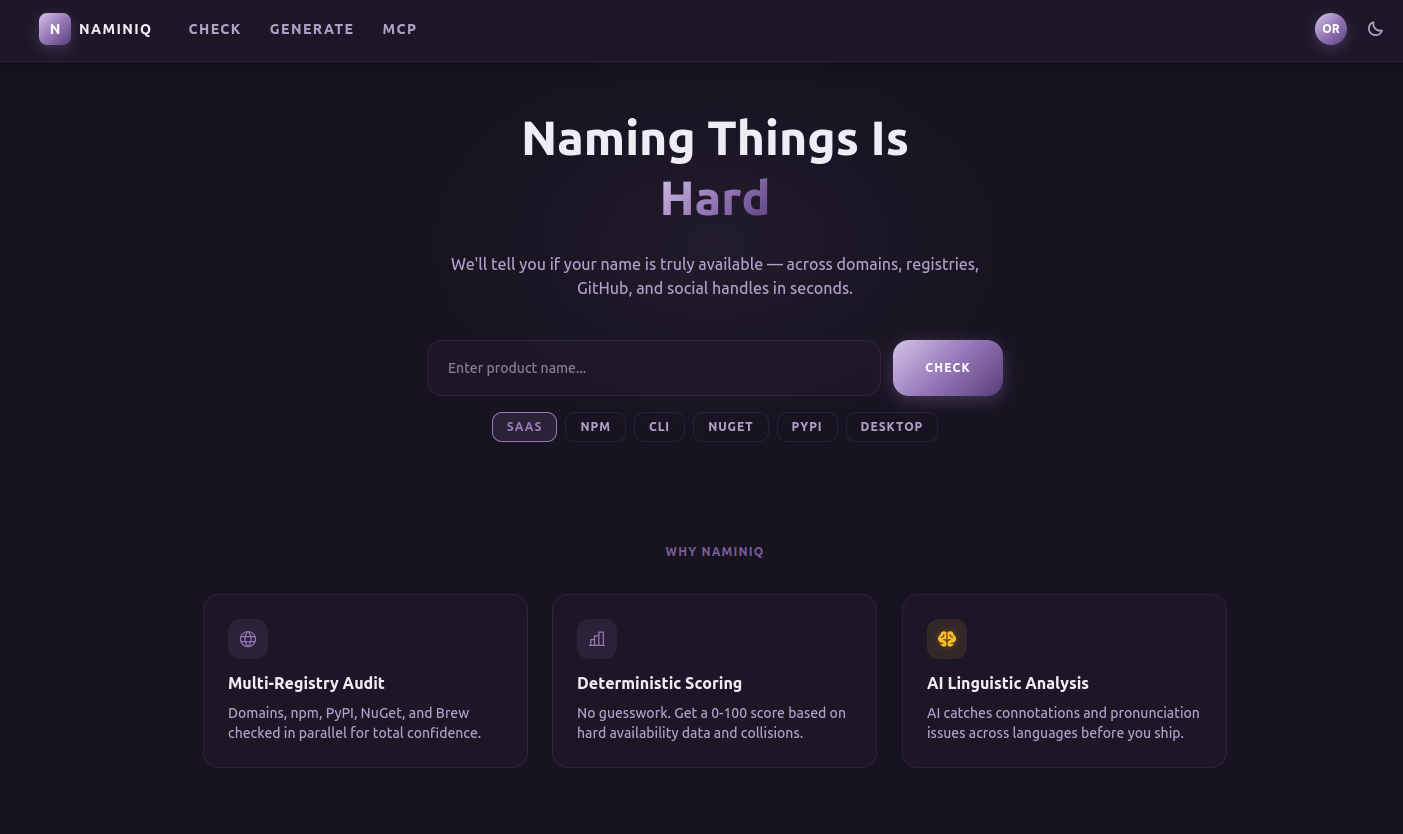
"Naming Things Is Hard" — the problem
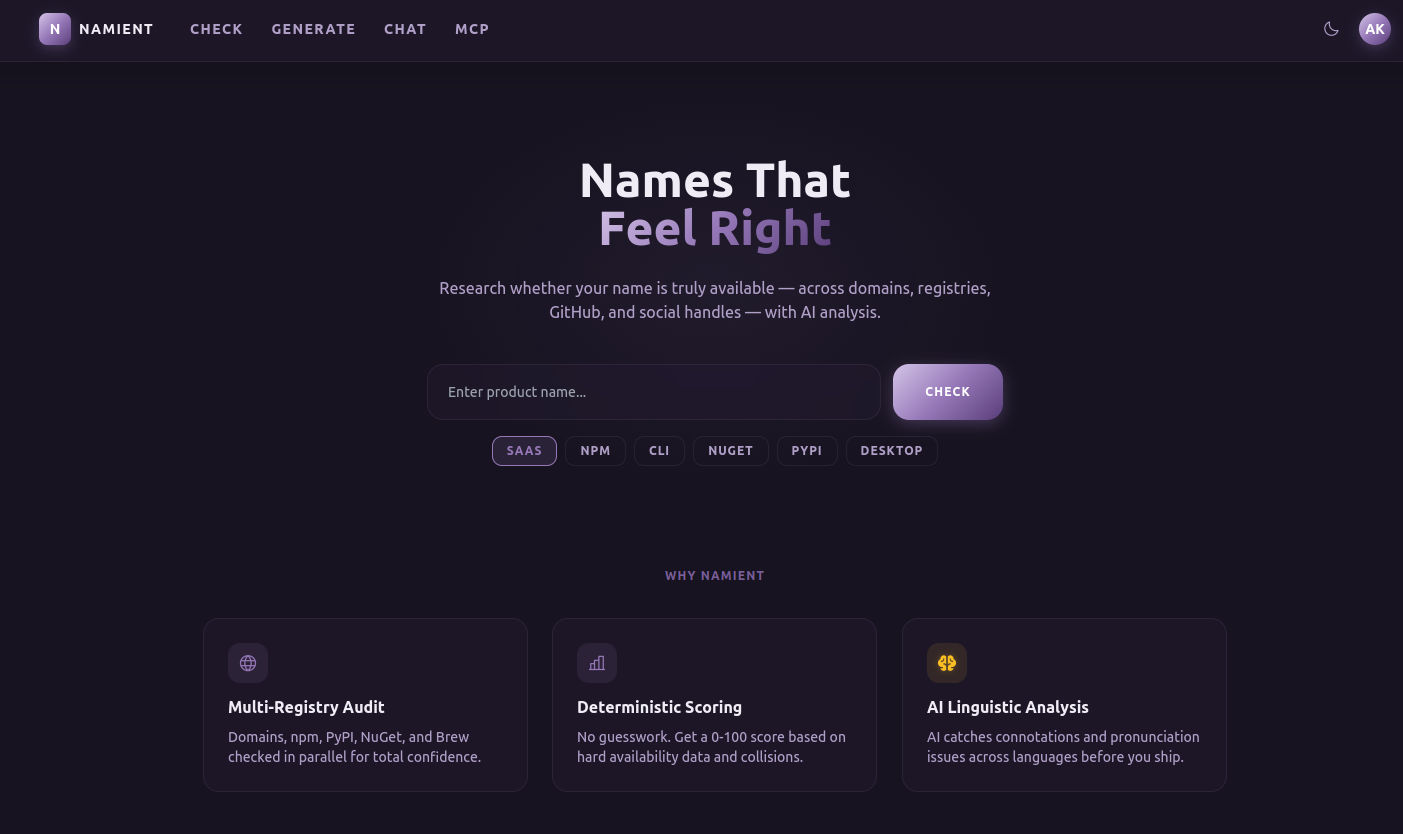
"Names That Feel Right" — the promise
The Decision
"Namient is the stronger decision as a name. Naminiq is the brighter decision as character."
By all rational metrics, Namient was ahead: perfect score, every domain free, natural spelling. But the real moment came when someone asked a simpler question:
"If our whole thing is 'names that feel right' — does our own name feel right?"
Naminiq had character. Namient had clarity.
One was memorable because it was unusual. The other felt inevitable.
That evening, Namient became real.
A Product That Named Itself
A naming tool used itself to find its own name. 200+ candidates. A positioning pivot none of us expected. And a final answer that changed how we think about what we're building.
People don't just need a lookup. They need to understand how a name lives — across platforms, across languages, across the feeling it creates. Not just "is it taken?" but "does it feel right?"
Your Turn
We used Namient to choose Namient.
Check whether your name is just available — or actually feels right.